
Foam Rolling for Mobility and Performance: A 2019 Review
Efficacy, Fluid Movement, and Fascial Health in Athletic Warm-ups

Introduction
Fascia is a connective tissue that surrounds bones, muscles, blood vessels, nerves, and organs throughout the body, providing stabilization and support due to its pliability. However, trauma or repetitive stress can lead to a decrease in pliability as collagen fibers within the fascia become dense and fibrous. This tension can negatively impact strength, endurance, and coordination. Myofascial release (MFR), a manual therapy technique developed by Barnes et al., was designed to reduce adhesions between fascial layers by applying targeted pressure and massage (1).
Because MFR requires a trained therapist, its cost and accessibility can be limiting. This has led to the increased popularity of self-myofascial release (SMR), particularly in sports and rehabilitation settings. SMR and MFR operate on the same principles, but while MFR requires a professional, SMR only requires a foam roller. By applying body mass on the roller, friction increases the temperature of the fascia and helps break up fibrous adhesions. Anecdotal evidence, as noted by MacDonald et al., suggests that foam rolling enhances neuromuscular efficiency, reduces joint stress and soreness, and improves range of motion (ROM) (4). As a result, SMR is widely used by strength and conditioning professionals for both recovery and pre-training preparation.
This critical review, originally written in 2019 during my university studies, seeks to analyze the acute effects of foam rolling on mobility and performance, exploring the rationale behind its rising popularity as a warm-up tool.

Review
Table 1 shows the studies considered in this review, all of which included at least one performance test and a control group. Control groups typically rested quietly while experimental groups underwent SMR interventions (2, 5, 6), except for one study where the control group performed a plank (3). This study also did not include any mobility tests. Three of the studies used a pre-post test design (2, 5, 6), while Healey et al. (3) employed a randomized crossover design without a pre-test, leaving unclear the magnitude of change after SMR.
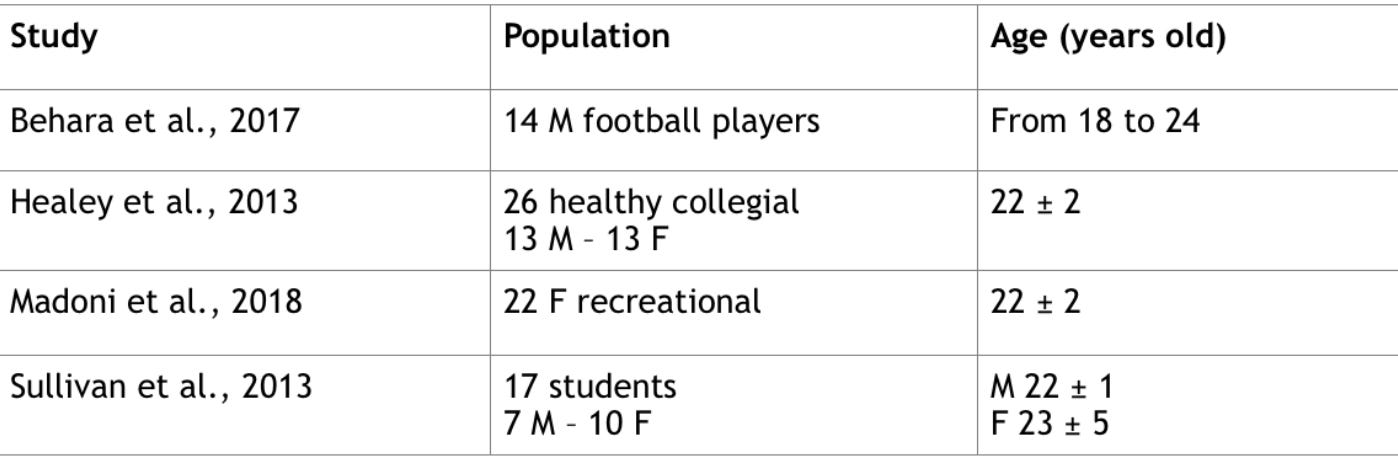
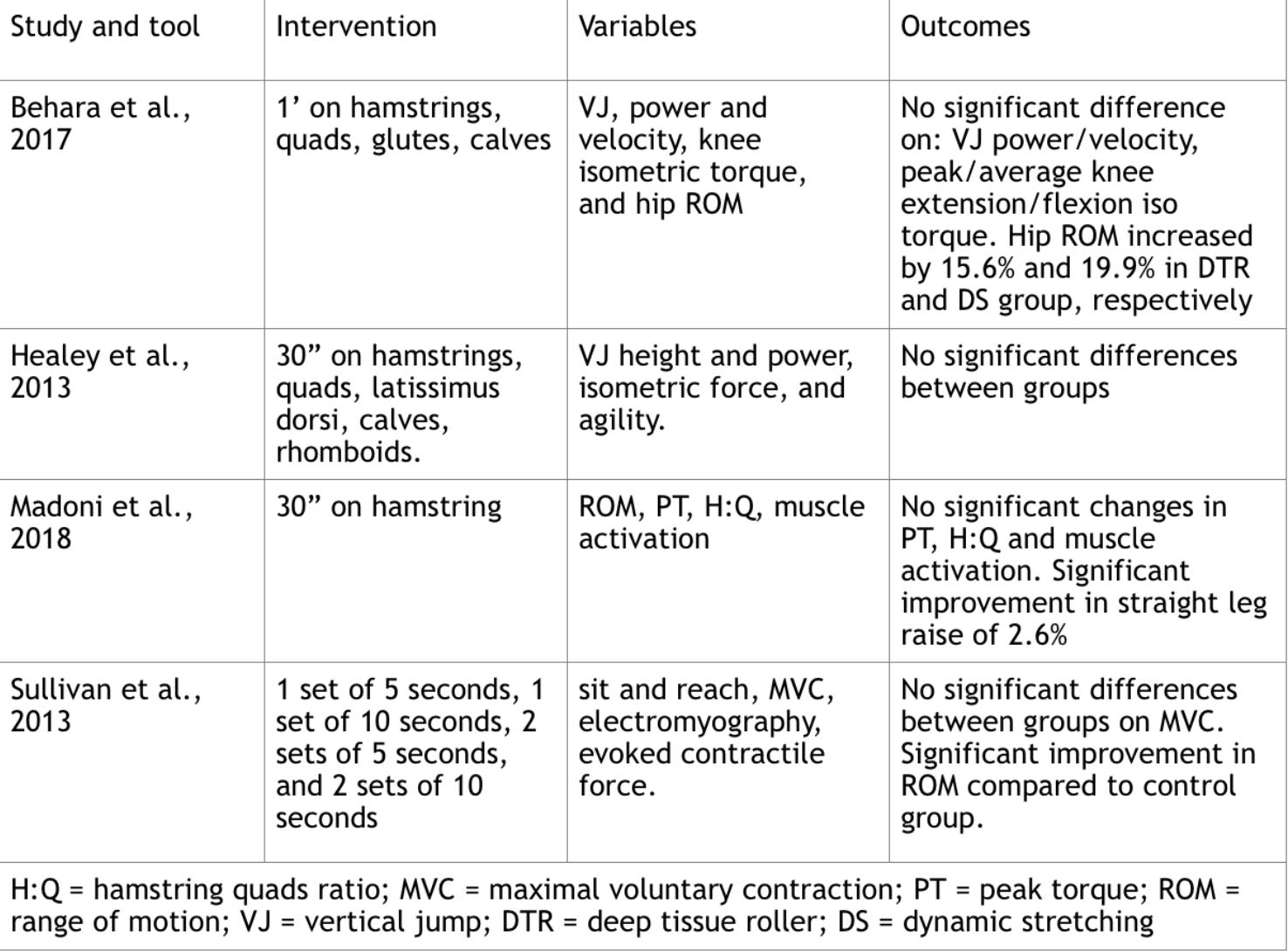
The findings suggest that SMR with a foam roller can improve ROM without any significant detrimental effects on performance (2, 3, 5, 6). Three studies demonstrated this improvement in ROM (2, 5, 6). However, Bahara et al. (2) found no significant differences in hip ROM or performance between foam rolling and dynamic stretching groups. A significant limitation of all the studies is the absence of reported effect sizes, making the magnitude of changes difficult to interpret. Some studies (2, 5, 7) observed slight reductions in performance, which, though not statistically significant, could be meaningful with a larger sample size.
Table 2 highlights variations in SMR protocols across studies, including differences in duration, targeted muscles, and tested variables. Peacock et al. (6) explored foam rolling in different directions (sagittal vs. frontal), finding no significant differences in performance tests but superior ROM improvements with anteroposterior rolling, likely due to targeting the hamstrings. Sullivan et al. (7) reported that longer durations of foam rolling tended to increase hamstring flexibility, though the effects of prolonged rolling or greater pressure remain uncertain.
References
1. Barnes, M. (1997). The basic science of myofascial release: Morphologic change in connective tissue. Journal of Bodywork & Movement Therapies, 1(4), 231-238.Behara, B. H., & Jacobson, B. (2017).
2. Acute Effects of Deep Tissue Foam Rolling and Dynamic Stretching on Muscular Strength, Power, and Flexibility in Division I Linemen. Journal of Strength and Conditioning Research, 31(4), 888-892.Healey, K. C., Hatfield, D. L., Blanpied, P. R., Dorfman, L., & Riebe, D. (2014).
3. The Effects of Myofascial Release With Foam Rolling on Performance. Journal of Strength and Conditioning Research, 28(1), 61-68.MacDonald, G. Z., Penney, M. D., Mullaley, M. E., Cuconato, A. L., Drake, C. D., Behm, D. G., & Button, D. C. (2013).
4. An Acute Bout of Self-Myofascial Release Increases Range of Motion Without a Subsequent Decrease in Muscle Activation or Force. Journal of Strength and Conditioning Research, 27(3), 812-821.Madoni, S. N., Costa, P. B., Coburn, J. W., & Galpin, A. J. (2018).
5. Effects of Foam Rolling on Range of Motion, Peak Torque, Muscle Activation, and the Hamstrings-to-Quadriceps Strength Ratios. Journal of Strength and Conditioning Research, 32(7), 1821-1830.Peacock, C. A., Krein, D. D., Antonio, J. J., Sanders, G., Silver, T., & Colas, M. (2015).
6. Comparing Acute Bouts of Sagittal Plane Progression Foam Rolling vs. Frontal Plane Progression Foam Rolling. Journal of Strength and Conditioning Research, 29(8), 2310-2315.Sullivan, K., Silvey, D., Button, D., & Behm, D. (2013).
7. Roller-massager application to the hamstrings increases sit-and-reach range of motion within five to ten seconds without performance impairments. International Journal of Sports Physical Therapy, 8(3), 228-36.
Takeaway Messages
The foam roller remains a key tool in my warm-up protocols for athletes for several reasons:
1. ROM Improvement: In my experience, foam rolling leads to immediate improvements in ROM, especially around the hips for tennis players. Given the demands of the sport—frequent decelerations and low stances—players often suffer from overactive quadriceps and restricted hamstrings. Foam rolling alleviates these imbalances.
2. Core Activation and Posture: Foam rolling not only targets fascia but also engages core muscles, particularly in the scapular area, as athletes assume challenging isometric positions. This activation primes the trunk for more dynamic movements.
3. Fluid Movement: One of the foam roller's crucial roles is enhancing the movement of bodily fluids such as water, blood, and lymphatic fluid. This helps improve circulation and supports lymphatic drainage, which can aid recovery and the removal of post-exercise metabolic waste. Additionally, foam rolling supports the sliding of multiple layers of fascia—superficial, deep, and visceral—promoting fascial mobility and health.
4. Hyaluronic Acid (HA) Circulation: HA is an essential component of the extracellular matrix (ECM) and synovial fluid, helping to increase viscosity and support tissue gliding. Located between layers of deep fascia, HA can act like water or glue depending on its state. Foam rolling, particularly when combined with multiplanar movement and mobility exercises, may support the circulation and function of HA, improving fascial hydration and reducing tissue friction. This not only enhances ROM but also contributes to long-term joint health.
5. Cardiovascular and Thermogenic Effects: By applying body weight to the foam roller, athletes elevate their heart rate and increase body temperature, creating a low-impact warm-up effect that prepares them for more intense physical activity.
Pros and Cons
Pros:
Recovery, Flexibility, and Fluid Stimulation: Current literature confirms the benefits of foam rolling for flexibility and recovery. It also enhances fluid movement, including lymphatic drainage and blood flow, promoting fascial and joint health. Additionally, it is widely recognized for its ability to reduce delayed onset muscle soreness (DOMS).
No Negative Impact on Strength or Power: Foam rolling does not impair strength or power, even when used before high-intensity exercise, according to recent studies.
Cons:
Mechanoreceptor Desensitization: Some studies suggest that excessive foam rolling, especially with high pressure, can temporarily desensitize mechanoreceptors, leading to diminished proprioception and motor control. Athletes should be cautious of overusing foam rolling prior to activities that require rapid neuromuscular responses.
Lack of Consensus on Optimal Protocols: Despite its widespread use, research has not yet established the ideal foam rolling protocols in terms of duration, intensity, and frequency. Further studies are needed to clarify best practices for different populations.
In summary, foam rolling remains a versatile and effective tool for warm-ups and recovery, but it is important to use it mindfully to avoid potential drawbacks such as mechanoreceptor desensitization and to optimize its benefits for fluid movement and fascial health. Additionally, responses to foam rolling can vary between individuals, so it is crucial for athletes and clients to understand how their own bodies react to ensure it is being used effectively